 Plano Gutter
Home / Gutter Work / Downspout Extensions and Buried Drains
Downspout Extensions and Buried Drains in Plano
The gutter gets the attention. The last ten feet do the work. On shrink-swell clay, where the downspout ends is the part of the system that touches the slab.
In Brief
The Foundation Performance Association's maintenance guide says downspouts should be tied into an underground drain or have aboveground extensions that carry water at least five to ten feet from the building.
The model residential code's roof drainage section uses five feet for areas with expansive soil. A downspout that ends at an elbow against the brick meets neither.
Three Ways to Finish a Downspout
| Ending | Reach | Good for | Watch for |
|---|---|---|---|
| Splash block | About 2 feet | Ground that already slopes well away | Too short for most Plano lots on its own |
| Aboveground extension | 4 to 10 feet | Side yards and beds; quick to add | Gets kicked, mowed over, disconnected |
| Buried line to a pop-up or curb outlet | 10 feet and more | Front yards, walks, anywhere an extension is in the way | Needs fall, a cleanout, and an outlet that stays clear |
An extension is the cheap experiment. Put one on the worst downspout and watch the next storm. If the puddle at the corner is gone, you have learned what a permanent line will do.
What a Buried Line Involves
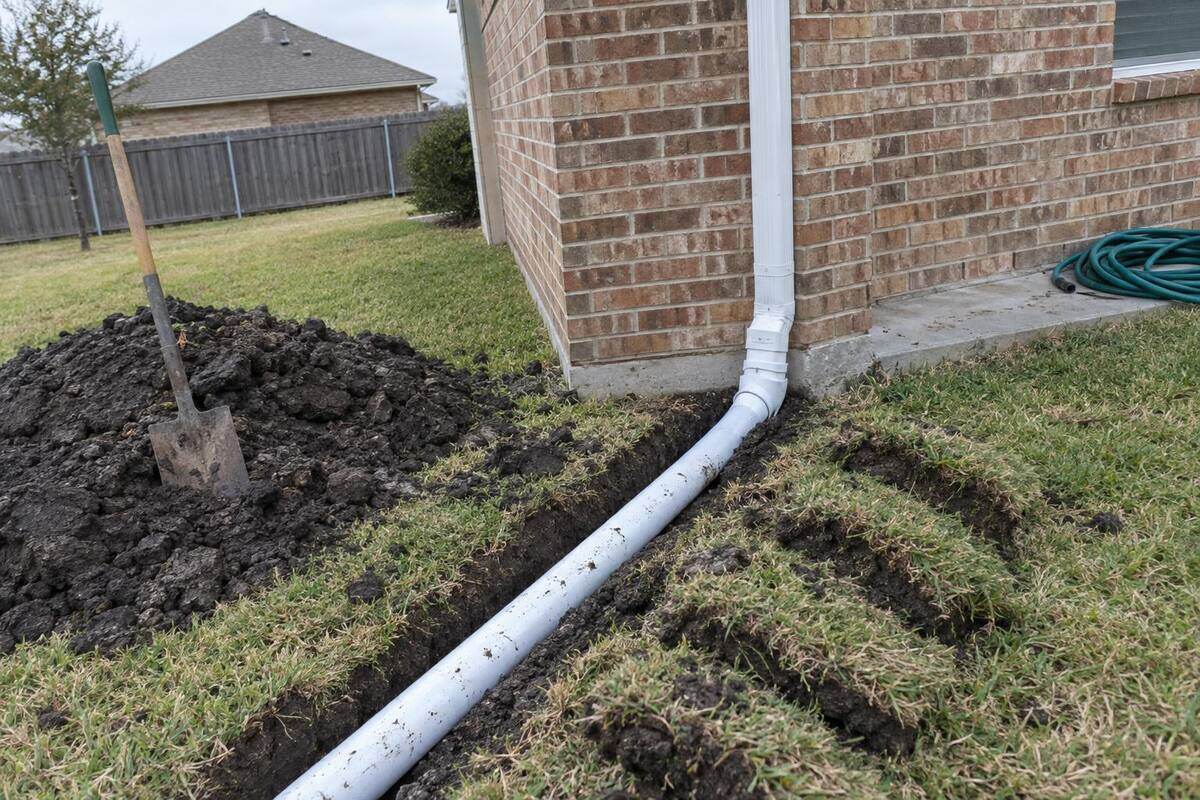
- A call to 811 before any digging, so gas, electric, cable and irrigation mains are marked. Sprinkler lines are private and are not marked; expect one to be found the hard way.
- A trench with steady fall from the downspout to the outlet. Flat spots hold water and silt up.
- Solid pipe, not perforated. The goal is to move roof water away, not to let it out along the way.
- A leaf filter or cleanout at the downspout, so debris can be removed without digging.
- An outlet: a pop-up emitter in the lawn, or a curb outlet where the city and the HOA allow one. Ask before cutting a curb.
Plano clay is dense and sticky when wet and hard as brick when dry. Trenching it by hand is slow. That labor is most of the price of a buried line.
Foundation Performance Association, Foundation Maintenance and Inspection Guide for Residential and Other Low-Rise Buildings, March 25, 2003. International Residential Code section R801.3. See the rules page for how far these could be confirmed for Plano.
Not gutter work: water that comes up from the ground, yards that hold water after the roof has drained, and retaining walls. Those are for a drainage contractor. Where discharge would cross onto a neighbor's lot or the street, ask the city and your HOA first; this site found no Plano rule to quote on it.
Why Even Moisture Is the Goal
Blackland clay cracks open in dry weather and closes when it rains. A slab does best when the soil all around it changes together. Four downspouts ending at four corners make four wet spots in a dry perimeter, which is the opposite. Carrying the water out into the yard lets it soak in where the house is not.
This site does not claim that extensions or drains will stop foundation movement. It reports what the engineers' guide recommends and leaves structural questions to structural engineers.
Questions People Ask
How far is far enough?
Five feet is the model code's figure for expansive soil and five to ten feet is the engineers' guide's. Farther is fine if the ground keeps falling away.
Will a pop-up emitter clog?
It can, with grit and roots. A filter at the downspout and a yearly check keep it working.
Can downspouts connect to my French drain?
Roof water is better kept in its own solid pipe. Feeding it into a perforated drain puts the water back in the soil you are trying to keep it out of.
Puddle at the Corner After Every Storm?
Say which downspout and what is in the way: walk, bed or driveway. A contractor will look at the options.
Call (469) 960-3734 Write It Down Instead